 English
 Chinese, Simplified
 Chinese, Traditional


28th November 2025
In the fast-evolving world of hospitality, automation is knocking at the door, but it’s not necessarily the end but rather the beginning of a new era. It’s a wake-up call for teams to double down on what makes humans irreplaceable: the warmth, intuition and genuine connection that turn simple interactions into lasting loyalty.
The hospitality industry never stands still and is constantly embracing innovation. Evidence of this fact is that over 70% of travel bookings in 2025 are now made online and AI chatbots are tackling everything from room service orders to basic FAQs. Yet, luxury resorts in Asia and beyond still continue to invest in human agents. Why? Because when it comes to high-stakes moments or human necessities – like an urgent flight rebooking or finding out what time breakfast ends – trust demands more than algorithms.
A call centre manager recently told us, ‘AI is like a torpedo aimed at us and we’re in a U-boat, we know it’s coming as we can hear the alarms are ringing.’ Looking forward, he added: ‘We’ve already started planning for the future. AI is a new era and it’s going to take a bite out of our cake. We need to look at what we can do better. We need to focus on our human elements of personalised service and by ensuring warmth and feeling in our calls we can increase the emotional value of the guest experience.’
The Rise of Automation: A Double-Edged Sword
AI excels at speed and scalability, offering guests convenience for routine matters. But would you trust a chatbot to fully grasp an important request without human confirmation? Or navigate a traveller’s panic over a cancelled flight?
Recent reports show that 59% of customers prefer human-led support, especially for complex issues, valuing understanding and problem-solving – particularly when delivered with clarity and cultural awareness. In Asia’s diverse call centres, where English is often a second language, this preference highlights a key truth: AI might handle the basics, but humans create the trust.
Deborah Short, former president of TESOL and author of National Geographic Learning’s Reach Higher, Lift, and Edge series, emphasised in her keynote speech ‘Developing Academic Language and Literacy: The Foundation of 21st Century Communication’: ‘AI can synthesise language. In contrast, humans produce language.’ It’s that authentic production, infused with empathy and nuance, that keeps us ahead.
The Unmatched Value of Human Agents
What skills will future proof your team? Here are the essentials that AI can’t replicate:
- Empathy and Emotional Intelligence: Pick up on frustration in a guest’s voice, ease tension, and adjust responses on the fly. As Forbes Travel Guide notes in its standards: personalised service is the benchmark for luxury – guests want to feel truly heard.
- Cultural Sensitivity: Adapt to global preferences, handling accents, idioms and customs from callers across Asia and beyond. This builds trust in multicultural interactions.
- Active Listening: Cut through language barriers by paraphrasing, asking clarifying questions, and validating concerns – reducing misunderstandings and call times.
- Creative Problem-Solving: Tackle unique requests, like a surprise proposal setup or allergy-safe menu tweaks, with improvisation that turns complaints into compliments.
These aren’t just nice-to-haves; they’re your edge in a hybrid world where AI frees agents for high-value calls. For instance, empathy turns a complaint about a noisy room into an opportunity to upgrade and impress, something a script can’t do. To build these in your team, especially with English as a second language, consider targeted training inspired by TESOL methods. Download our free guide with practical activities to get started.
FREE DOWNLOAD: “Future-Proof Your Call Centre: Four TESOL Activities AI Can’t Teach”
The Hybrid Future: Humans and AI can Coexist
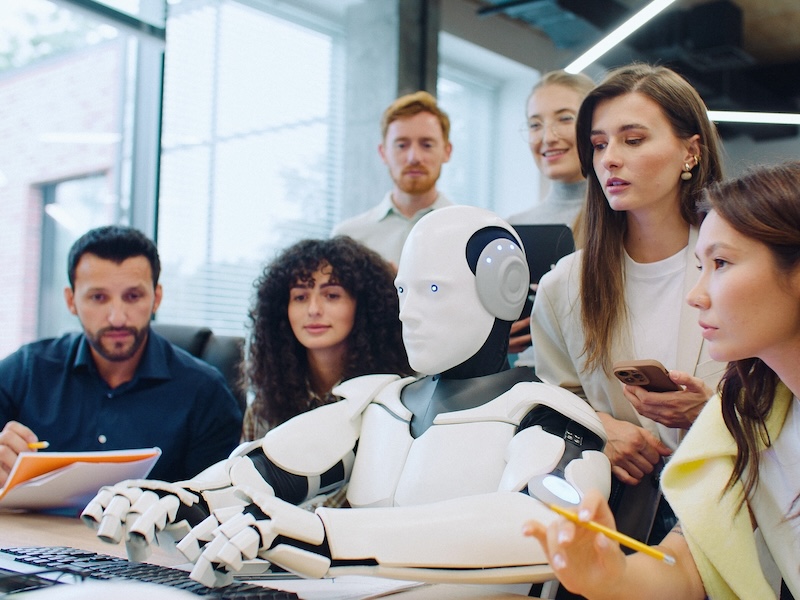
Critics argue that AI will replace jobs, but the reality is more nuanced. AI handles repetitive tasks, freeing agents to focus on high-value interactions requiring language precision and cultural awareness – areas where targeted training delivers on ROI and enhances the guest experience.
Looking ahead to 2026 and beyond, Gartner predicts AI will autonomously resolve up to 80% of routine customer-service issues by 2029. In luxury hospitality, this means a true partnership: AI summarises calls, flags emotions, and suggests next steps, while your agents become experienced curators who turn panic into delight. Organisations already using AI-augmented agents resolve 14% more issues per hour, which is proof that technology amplifies talent, it doesn’t erase it. The hotels that win tomorrow are the ones investing today in the skills that no algorithm can copy: warmth, intuition and the ability to make every guest feel like the only person in the world.
So here’s the simple truth: AI isn’t coming for your job. It’s coming for mediocrity. It’s coming for complacency. Master the human elements – empathy, cultural fluency, creative problem-solving – and your team won’t just survive the AI era. You’ll own it.